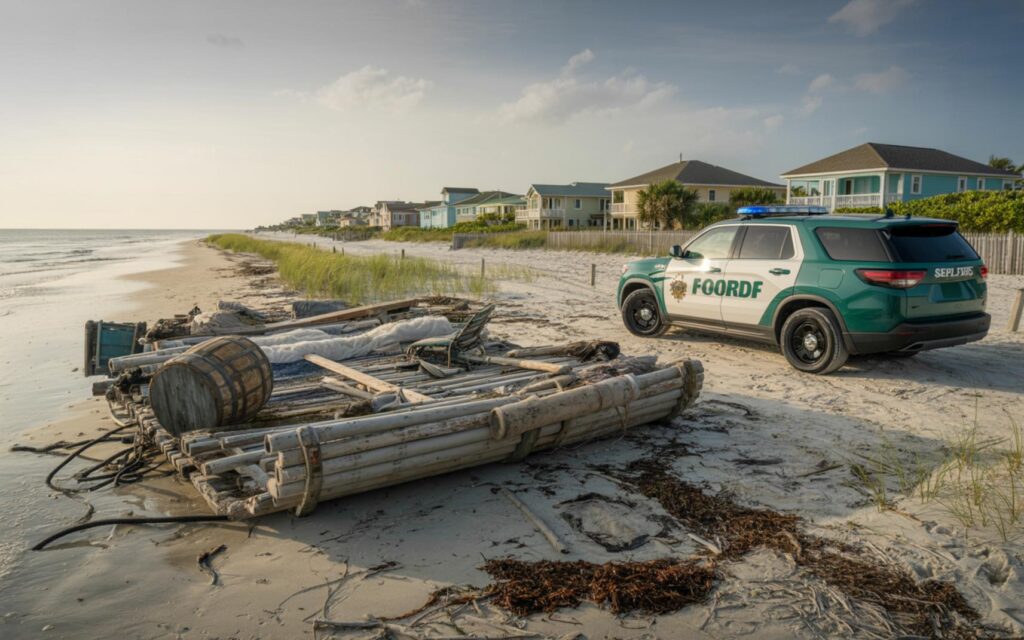
A makeshift raft washed ashore on Jupiter Island, Florida, drawing renewed attention to maritime smuggling concerns along Florida’s coastline. The incident, which began with the raft being seen near the Florida Keys days earlier, highlights ongoing challenges faced by authorities in the region.
Makeshift Raft Incident on Jupiter Island
The arrival of the makeshift raft on Jupiter Island has prompted local and federal agencies to assess the situation. According to official sources, the raft was first observed drifting near the Florida Keys before washing ashore in Martin County. Authorities believe recent storm systems and strong wave activity caused the raft to travel north, rather than any intentional landing attempt at Jupiter Island.
There is no evidence, according to Martin County officials, that anyone disembarked from the raft or that a recent landing occurred in the area. The discovery is being treated as an isolated incident, with no immediate signs of unauthorized entry or smuggling activity directly linked to the raft.
Maritime Smuggling and Illegal Migration in Florida
The presence of a makeshift raft on Florida’s coast is not uncommon. According to federal and state agencies, such vessels are often associated with attempts by migrants to reach the United States from the Caribbean. These efforts typically increase during periods of political or economic instability in neighboring countries.
Martin County and the broader South Florida region have experienced frequent encounters involving immigration enforcement. Officials report that the discovery of rafts, whether occupied or abandoned, underscores persistent vulnerabilities in coastal border security.
Patterns of Unauthorized Maritime Migration
According to the U.S. Coast Guard and U.S. Customs and Border Protection, makeshift rafts are sometimes found after drifting for days or weeks. Not every raft discovery signals a successful migration or smuggling event, but each incident is treated as a potential risk to public safety and border integrity.
Authorities emphasize that ongoing vigilance is necessary to address both immediate threats and the broader issues driving maritime migration attempts.
Weather Conditions and Drifting Vessels
Recent weather events have played a significant role in the movement of vessels along the Florida coast. According to National Weather Service data, storm systems and strong currents can cause rafts and other small boats to drift far from their original course.
This complicates efforts by agencies to determine the origin and intent of vessels found along the shoreline. Officials note that weather-related drift events can result in vessels washing ashore hundreds of miles from their starting point.
Challenges for Local and Federal Agencies
The discovery of a makeshift raft on Jupiter Island demonstrates the complex challenges faced by authorities. Agencies must balance humanitarian concerns, border enforcement, and public safety while responding to each incident.
According to federal officials, interagency cooperation is essential for monitoring and responding to suspected smuggling and unauthorized migration attempts. Local law enforcement, the U.S. Coast Guard, and federal immigration agencies regularly coordinate efforts in the region.
Interagency Response and Ongoing Vigilance
Federal, state, and local agencies maintain a coordinated approach to maritime security in South Florida. According to official sources, joint patrols, surveillance operations, and rapid response protocols are used to identify and address potential threats along the coastline.
Officials report that ongoing vigilance is necessary to manage both the immediate risks posed by unauthorized maritime arrivals and the underlying causes of such attempts. The presence of makeshift rafts serves as a reminder of the dynamic and evolving nature of border security in the region.
Broader Implications for Coastal Security
Experts highlight that each discovery of a makeshift raft, even when unoccupied, points to persistent vulnerabilities in Florida’s coastal defenses. The region’s proximity to the Caribbean and frequent storm activity create unique challenges for authorities.
According to immigration enforcement agencies, proactive monitoring and strong interagency cooperation are essential for effective border management. The incident on Jupiter Island is being reviewed as part of ongoing efforts to strengthen maritime security and address the factors driving unauthorized migration.
Frequently Asked Questions About Makeshift Raft Jupiter Island
What is a makeshift raft and why are they found near Jupiter Island?
A makeshift raft is a vessel often built from basic materials, sometimes used by migrants attempting to reach Florida. They are occasionally found near Jupiter Island due to currents and weather, not always because of intentional landings.
How do authorities respond when a makeshift raft washes ashore?
When a makeshift raft is found, local, state, and federal agencies investigate to determine if anyone landed and to assess any potential risks. They also check for signs of recent activity or unauthorized migration.
Are makeshift rafts always linked to illegal migration or smuggling?
Not every makeshift raft is connected to illegal migration or smuggling. Some may drift ashore empty due to weather or currents, but all discoveries are reviewed by officials for possible security concerns.
Can you track where a makeshift raft originated?
Tracking the origin of a makeshift raft can be difficult, especially after storms or strong currents. Authorities use available evidence and weather data to estimate where the vessel may have started its journey.
Where are the most common areas for rafts to wash ashore in South Florida?
Rafts are often found along the coasts of Martin County, the Florida Keys, and other parts of South Florida. These areas are monitored closely by agencies due to frequent maritime activity.